Performance snapshot — Prayagraj
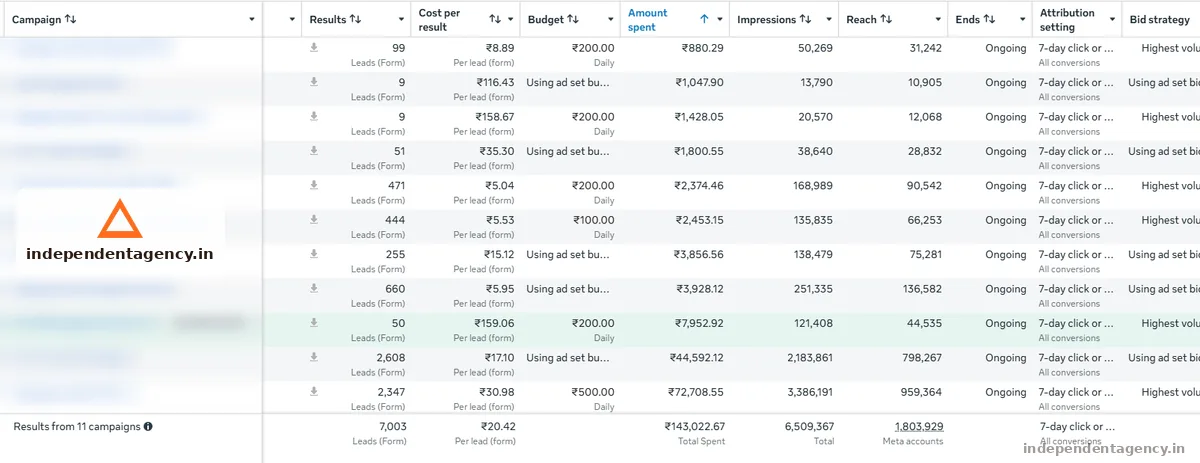
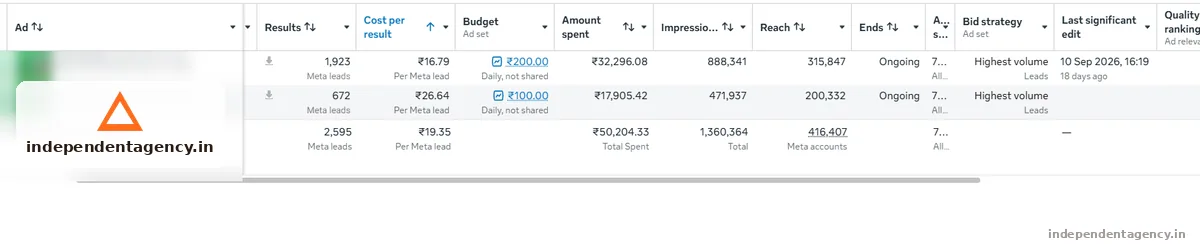
Every figure below is read directly from the ad accounts. Where two accounts ran in this city, they are shown separately rather than merged, because they used different objectives and periods.
| Metric | Account 1 (11 campaigns) | Account 2 (2 ads) |
|---|---|---|
| Leads (Instant Form) | 7,003 | 2,595 |
| Spend | ₹1,43,022+ | ₹50,204.33 |
| Cost per lead | ₹20.42 | ₹19.35 |
| Best / worst in account | ₹5.95 / ₹159.06 | ₹16.79 / ₹26.64 |
| Impressions | 6,509,367 | 1,360,364 |
| Reach | 1,803,929 | 416,407 |
| Frequency (impr ÷ reach) | 3.6 | 3.3 |
| Period | Through September 2026 | Through September 2026 |
Performance figures on this page come from selected campaigns and reporting periods in our portfolio records through September 2026. Several screenshots are filtered views of the same ad account, so totals are calculated from distinct accounts only. Results vary with market, budget, targeting, offer, competition and sales follow-up.
Our work in Prayagraj
The first account grew the way most accounts grow: a new campaign for every idea. Eleven campaigns, several of them tests that never scaled — one sat at ₹159.06 per lead on ₹7,952 of spend. The two campaigns that worked carried 4,955 of the 7,003 leads between them.
The second account had already been consolidated. Two ads, ₹50,204 spent, 2,595 leads. One ad at ₹16.79, the other at ₹26.64. No test budget sitting idle, no learning phases restarting.
Both landed near ₹20 per lead. The difference is not the result — it is the effort and the waste required to get there. The eleven-campaign account spent roughly ₹15,000 on campaigns that never found an audience. That is the real cost of not consolidating.
Too many campaigns, not enough budget in each?
That is the most common structural problem we see in solar accounts. We will map your current structure against what the spend can actually support.
Campaign screenshots
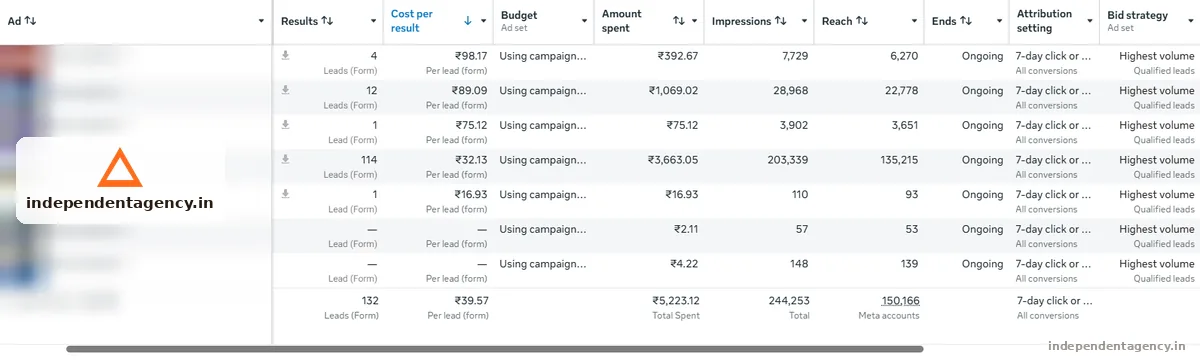
Client names, campaign names, ad names and creative thumbnails are blurred. Every number to the right of that column is exactly as the platform reported it.
What consolidation actually involves
Merging campaigns is not simply deleting the weak ones. When a campaign is removed, its learning data goes with it, and the remaining campaign restarts its own learning phase because the budget it now receives is different from what it was optimised for.
The sequence that has worked for us: identify the two or three campaigns carrying real volume, raise their budgets gradually rather than doubling them overnight, cap the remaining campaigns instead of pausing them, and give the account seven to ten days before judging the result. Doubling a budget in one step usually resets delivery and produces a week of expensive leads that look like the change failed.
Reading a Prayagraj campaign table
| What you see | Likely cause | What we do |
|---|---|---|
| A campaign at ₹159 per lead | Test that never found delivery | Cap it, keep it live as a control |
| Two campaigns carrying 70% of leads | The account has found its angle | Fund these, stop adding new ones |
| Several campaigns under ₹5 spend | Budget spread too thin to deliver | Consolidate before judging them |
| Blended CPL stable, volume falling | Audience saturating | New creative or a wider geography |
Why we do not delete underperformers
A capped campaign costs very little and remains a valid comparison point. When the market shifts — a subsidy announcement, a competitor entering, a seasonal swing — having a campaign that was running through the change tells you whether the shift is yours or the market's. Deleting it means the next time cost per lead moves, you are guessing.
Services used for this work
- Meta Ads — Instant Form lead campaigns
- Campaign consolidation and budget restructuring
- Creative angle testing
- Cost-per-lead and frequency monitoring
What this market taught us
More campaigns is not more control. Every new campaign restarts a learning phase and splits the budget signal. In the eleven-campaign account, the small tests each ate a few thousand rupees while delivering leads at five to eight times the account average.
Consolidation has a limit. The two-ad account is efficient, but it is also fragile — if either creative fatigues, there is nothing waiting to take over. We would rather run three or four funded ads than two, even if the blended number is slightly worse.
Read a zero-result row by its spend column. Two ads in the seven-ad test below spent under ₹5 and returned nothing. That is the auction not giving them delivery, not a creative that failed. Judging them as failures would remove angles that were never actually tested.
Want the consolidated structure applied to your account?
We will show you which campaigns to merge, which to cap and which to leave alone — before touching anything.
Frequently asked questions
What does a solar lead cost in Prayagraj?
Across two accounts, ₹20.42 and ₹19.35 blended. Individual campaigns ranged from ₹5.95 to ₹159.06 — the high end being small tests that were capped rather than scaled.
Should I run many campaigns or a few?
Our Prayagraj data points toward fewer, better-funded campaigns. Both accounts reached about ₹20 per lead, but the eleven-campaign account spent roughly ₹15,000 getting there that the consolidated account did not.
Do cheaper leads convert worse?
Sometimes. Broader audiences and softer hooks produce cheaper leads that need more qualifying on the phone. We recommend tracking connection rate and site-visit rate alongside cost per lead rather than optimising for the cheapest number.
How do you decide which campaigns to pause?
We cap rather than delete. A paused campaign loses its learning phase if restarted later, so under-performers get their budget reduced and stay live as a comparison point.
Is this data from one client?
No — two separate solar accounts running in Prayagraj. They are shown separately rather than merged because their objectives and periods differ.