Performance snapshot — Varanasi
Every figure below is read directly from the ad accounts. Where two accounts ran in this city, they are shown separately rather than merged, because they used different objectives and periods.
| Metric | Performance |
|---|---|
| Campaigns | 6 |
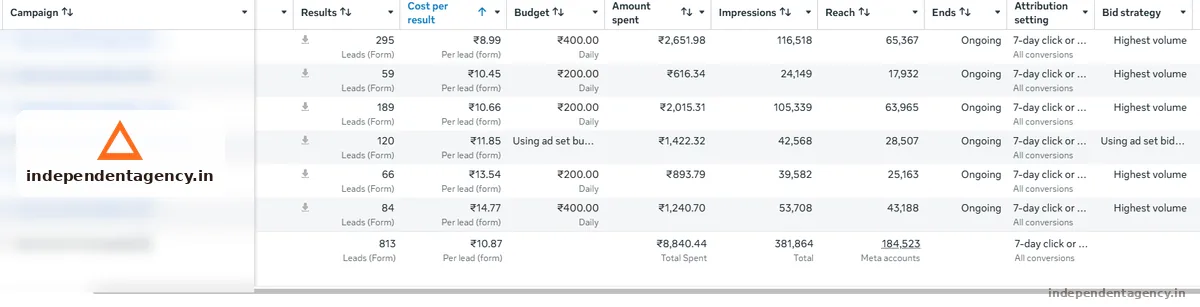
| Leads (Instant Form) | 813 |
| Spend | ₹8,840.44 |
| Cost per lead (blended) | ₹10.87 |
| Best / worst campaign | ₹8.99 / ₹14.77 |
| Impressions | 381,864 |
| Reach | 184,523 |
| Frequency (impr ÷ reach) | 2.1 |
| Daily budgets | ₹200 – ₹400 |
| Period | Through September 2026 |
Performance figures on this page come from selected campaigns and reporting periods in our portfolio records through September 2026. Several screenshots are filtered views of the same ad account, so totals are calculated from distinct accounts only. Results vary with market, budget, targeting, offer, competition and sales follow-up.
Our work in Varanasi
Six campaigns, modest daily budgets of ₹200 to ₹400, broad audiences and Instant Forms. The tightest campaign ran at ₹8.99, the widest at ₹14.77 — a narrow band, which usually means the offer matched the market rather than any one campaign being clever.
Frequency stayed around 2.1, meaning the audience was nowhere near saturated. That is part of why cost stayed low: we were still reaching new people rather than re-showing ads to the same ones.
We have not scaled this account aggressively, and that is deliberate. Pushing budget on a broad-audience form campaign is the fastest way to turn a ₹11 lead into a ₹40 lead while also lowering lead quality. The honest answer for a market like this is to grow spend gradually and watch the connection rate, not the cost per lead.
Getting cheap leads that never pick up the phone?
Cheap and useless are not the same thing, but they look identical in the ads dashboard. We will help you separate them.
Campaign screenshots
Client names, campaign names, ad names and creative thumbnails are blurred. Every number to the right of that column is exactly as the platform reported it.
What a cheap lead asks of your sales team
An Instant Form lead at ₹10.87 arrives with a name, a phone number and very little intent behind it. The form is two taps inside Facebook; the person did not visit a website, did not read about payback periods and may not remember filling it in an hour later.
That is not a reason to avoid cheap leads. It is a reason to staff for them. In our experience a ₹11 market needs the first call within minutes, a second and third attempt at different times of day, and a WhatsApp follow-up for the ones who never pick up. Businesses that treat a ₹11 lead the way they treat a ₹200 referral get poor results and blame the campaign.
Numbers worth tracking alongside cost per lead
| Metric | Why it matters | Where it comes from |
|---|---|---|
| Connection rate | How many leads you actually reach | Your call log, not the ads dashboard |
| Site-visit rate | Whether interest survives a phone call | Sales team follow-up |
| Cost per connected lead | The honest version of CPL | Spend ÷ leads reached |
| Time to first call | The single biggest lever on connection rate | CRM timestamp |
Cost per connected lead is the figure we would quote if the industry used it. A ₹11 lead with a 30% connection rate costs ₹37 to actually speak to. A ₹40 lead with an 80% connection rate costs ₹50. Suddenly the two markets look similar, which is closer to the truth.
Scaling a low-cost market without breaking it
Frequency in this account sat around 2.1, meaning the audience was still fresh. Raising budget on the same audience pushes frequency up and cost per lead follows. The sequence that works is widening geography first, then adding a second creative angle, then raising budget — in that order, with a week between each step.
Services used for this work
- Meta Ads — Instant Form lead campaigns
- Audience and geography structuring
- Lead quality review with the client's sales team
What this market taught us
A low cost per lead is a starting point, not a result. Broad-audience Instant Forms are cheap because the form is easy to fill in. The leads need heavier qualification on the phone than a ₹40 lead from a narrower audience typically does. If the sales team cannot absorb the volume, a ₹11 lead is worth less than a ₹40 one.
Low frequency is what kept it cheap. At 2.1, the audience was still fresh. The moment frequency climbs past 3, cost per lead in this category starts drifting up regardless of what else is optimised.
Do not quote one city's number as a promise. Varanasi at ₹10.87 and Delhi NCR at ₹63.11 are both ours, in the same category, in the same period. Any agency quoting a single national cost per lead for solar is either guessing or cherry-picking.
Planning to scale a campaign that is working right now?
Adding budget to a broad-audience form campaign is the fastest way to break it. There is a safer sequence.
Frequently asked questions
Is ₹10.87 a realistic cost per lead for solar?
It is real — six campaigns, ₹8,840 spent, 813 leads. But it came from broad-audience Instant Form campaigns on small daily budgets in a Tier-2 market. The same approach in Delhi NCR cost ₹63.11 per lead.
Do cheap leads mean poor quality?
Not automatically, but they usually need more qualification. We recommend tracking connection rate and site-visit rate alongside cost per lead so you can see what the number is actually buying.
Can this be scaled to ten times the budget?
Not directly. Increasing budget on a broad-audience campaign raises frequency, and cost per lead rises with it. Scaling means adding audiences and creative, not just money.
What budget did these campaigns run on?
Daily budgets between ₹200 and ₹400 per campaign.
Do you run Google Ads for solar in Varanasi?
Not in this account. Our solar Google Ads data comes from a Lucknow account, where a search conversion cost ₹339.19 — a different kind of lead from a Meta form fill.