Performance snapshot — Bareilly
Every figure below is read directly from the ad accounts. Where two accounts ran in this city, they are shown separately rather than merged, because they used different objectives and periods.
| Metric | Performance |
|---|---|
| Ads | 4 |
| Leads (Instant Form) | 3,011 |
| Spend | ₹73,965.94 |
| Cost per lead (blended) | ₹24.57 |
| Winning angle | ₹23.82 and ₹23.95 |
| Second angle | ₹87.59 and ₹97.04 |
| Impressions | 1,970,404 |
| Reach | 558,172 |
| Frequency (impr ÷ reach) | 3.5 |
| Daily budget per ad | ₹250 |
| Period | Through September 2026 |
Performance figures on this page come from selected campaigns and reporting periods in our portfolio records through September 2026. Several screenshots are filtered views of the same ad account, so totals are calculated from distinct accounts only. Results vary with market, budget, targeting, offer, competition and sales follow-up.
Our work in Bareilly
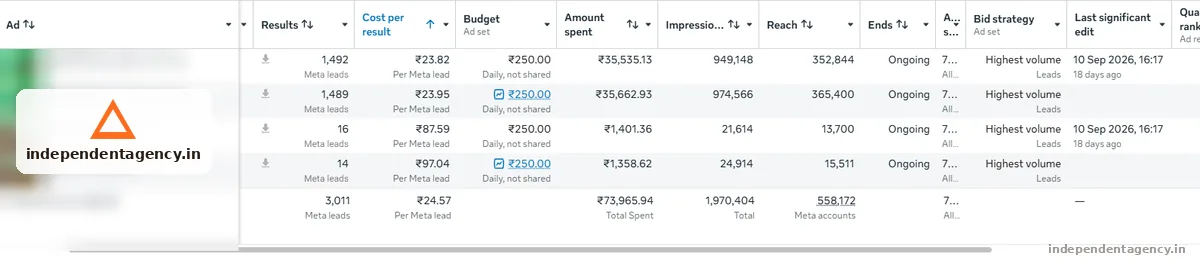
Four ads ran against the same offer in Bareilly on identical ₹250 daily budgets. Two used one creative angle and returned 1,492 and 1,489 leads at ₹23.82 and ₹23.95. Two used a different angle and returned 16 and 14 leads at ₹87.59 and ₹97.04.
The detail worth pausing on is that the two winners landed within fifteen paise of each other. When two independent ads on the same angle converge that tightly, the result is the angle — not luck, not timing, not the algorithm having a good week. That is the point at which it is safe to scale.
The two losing ads together consumed about ₹2,760 and produced 30 leads. That is the entire cost of finding out. Against an account that went on to spend ₹74,000 at ₹24, it is the cheapest information in the campaign.
Stuck at one creative angle that used to work?
Creative fatigue looks exactly like a market getting expensive. We will tell you which one you are dealing with.
Campaign screenshots
Client names, campaign names, ad names and creative thumbnails are blurred. Every number to the right of that column is exactly as the platform reported it.
How to run a creative test that gives you an answer
The Bareilly result was clean because the test was set up to be readable, not because the creative was inspired. Four conditions make a test worth trusting.
Identical budgets. All four ads ran at ₹250 daily. If budgets differ, delivery differs, and you are comparing the auction rather than the creative.
Two ads per angle. One ad winning could be anything. Two ads on the same angle landing within fifteen paise of each other is a result.
Same audience and placement. Change one variable at a time, and make that variable the message.
Let it finish. Each ad needs to exit the learning phase. On these budgets that took roughly two weeks. Calling a winner on day three is calling noise.
Angles worth testing in solar
| Angle | What it promises | When it tends to work |
|---|---|---|
| Bill savings | A number on the monthly bill | Broad audiences, high bill anxiety |
| Subsidy eligibility | Money the government pays | When a scheme is in the news |
| Payback period | Investment framing | Commercial and larger residential |
| Rooftop suitability | A check, not a pitch | Cold audiences, low awareness |
| Product specification | Panel brand, efficiency, warranty | Late-stage, comparison shoppers |
The last row is where most solar advertising starts and it is usually the wrong opening move. Someone who has not decided whether to buy solar at all does not care whose panel it is.
What the losing creative cost
The two weak ads consumed roughly ₹2,760 and produced 30 leads. That is the price of the answer. Against an account that went on to spend ₹74,000 at ₹24 per lead, it was the cheapest money in the campaign — and an account that skips the test pays the ₹90 rate without ever knowing there was a ₹24 option.
Services used for this work
- Meta Ads — Instant Form lead campaigns
- Structured creative angle testing
- Budget reallocation once a winner is confirmed
What this market taught us
Test angles, not variations. Changing a headline or a colour rarely moves cost per lead. Changing what the ad is fundamentally about — bill savings versus subsidy eligibility versus rooftop suitability — moves it by multiples.
Two ads per angle, not one. A single ad winning tells you very little. Two ads on the same angle converging on the same cost is what makes the result trustworthy. This costs a little more and removes most of the guesswork.
A losing creative costs more than a different city. The ₹97 ad in Bareilly was more expensive per lead than every market we have run except Delhi NCR and Gurugram. Agencies that report only city averages hide exactly this.
Want a proper creative test run on your account?
Two ads per angle, at least two angles, budgets that let each one finish. Usually under ₹3,000 to find the winner.
Frequently asked questions
What does a solar lead cost in Bareilly?
The account blended to ₹24.57. The working creative angle ran at roughly ₹24; a second angle on identical budgets cost ₹87 to ₹97 per lead.
How many creatives should I test?
At minimum two ads per angle, and at least two genuinely different angles. Our Bareilly test used four ads and cost about ₹2,760 to identify the winner.
How long should a creative test run?
Long enough for each ad to exit the learning phase, typically two to three weeks on the budgets we ran here. Calling a winner in three days usually means calling noise.
Why not just pause the expensive ads immediately?
Because early cost per lead is unstable. We cap budgets on weak performers and let them finish rather than deleting them, so the comparison stays valid.
Do these results transfer to other cities?
The angle usually does; the absolute cost does not. The same winning angle ran near ₹24 in Bareilly and well above ₹50 in Delhi NCR.